
Agentic Product
Management
The AI Agent revolution has created new trends in Product Management too. Faster, easier to implement and 0 risk and see results.
Benefits for Companies
The difference between traditional approaches and Agentic Product Management.
2 Core Roles
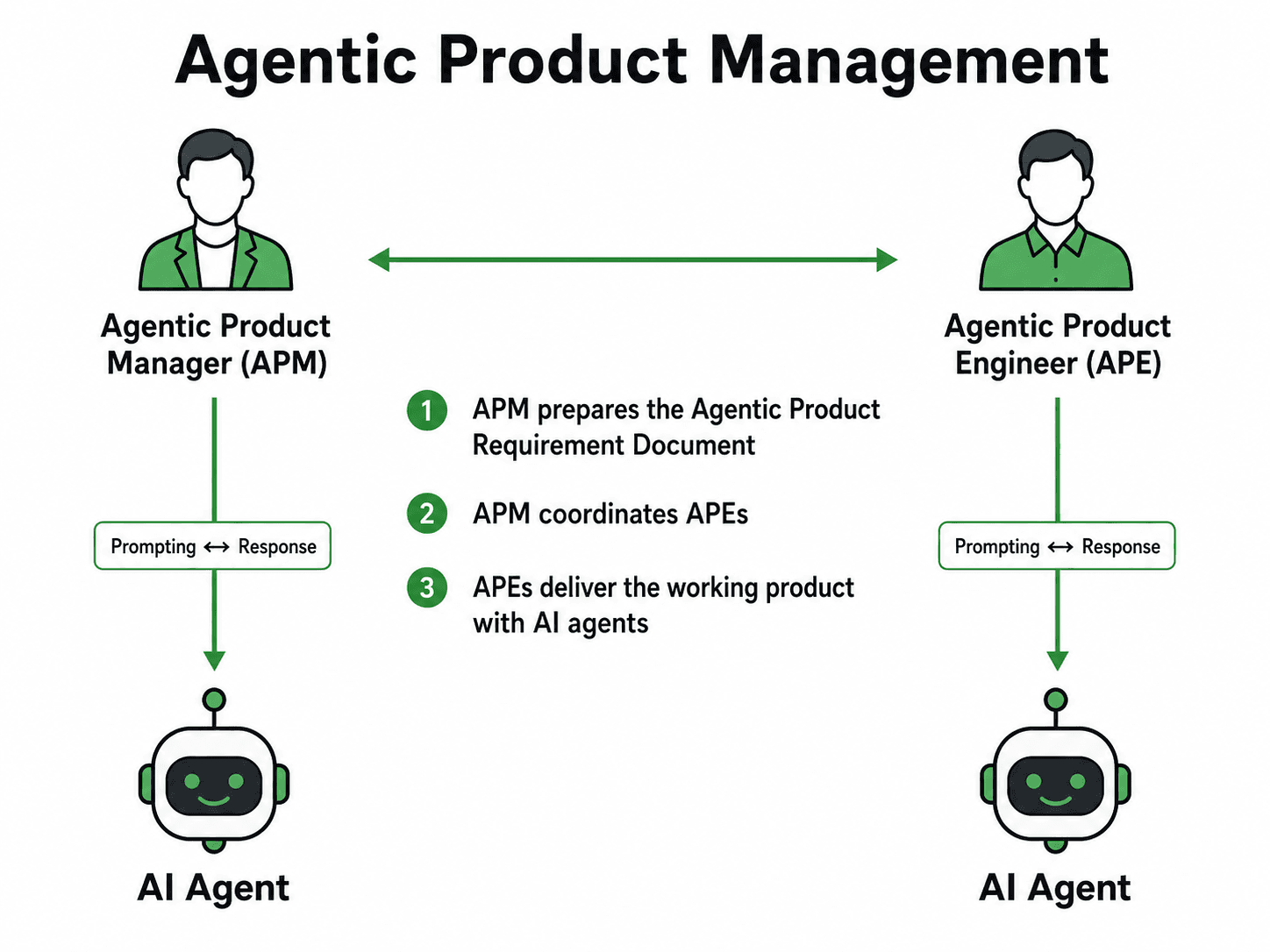
Agentic Product Management is built on 2 roles. If the team has mastered "Agentic System Thinking" skills in these roles, the probability of successful agentic transformation is high. Because management is driven purely by numbers.
Agentic Product Manager (APM)
Agentic Product Engineer (APE)
Agentic Product Manager
Replaces the PO, Scrum Master, Business/Technical Analyst and others in traditional and agile approaches. Precisely analyzes all customer needs in hours using AI agents, quickly prepares an APRD (Agentic Product Requirement Document) and presents it to Agentic Product Engineers.
- Combines PO, Scrum Master, BA roles
- Precise requirements analysis in hours
- Prepares APRD (business + technical)
- Manages the entire project
Agentic Product Engineer
Covers all types of engineers regardless of platform, domain, frontend, backend, or fullstack. The key issue is managing the codebase in the repository using AI Agents. Instead of 4,000 lines of code per month, now in a few hours. Main goal: Time-to-market measured in days and weeks.
- Covers all types of engineers
- Responsible for the codebase
- 10x–50x speed via AI Agent
- Engineer builds the architecture
Core Requirements When Implementing
Agentic Product Management
PROCESS REQUIREMENTS
MEASURABLE INDICATORS
Core AI Prompting Requirements in
Agentic Product Management
The agent must know exactly which files it will work with
The control mechanism must be with the APE.
Inputs and outputs must be precisely defined
Input/output must be clearly defined in every prompt.
HOWs must not be specified
HOWs must be determined by the Agents. You define the WHAT.
There must be a Point Effect
The intersection point must be precisely indicated for the complete establishment of relationships between components, databases, and classes.
ARTICLES
Related Articles

Agentic MVP Development Starts With Structured Product Communication

How Will the Product Manager of the Future Manage AI Agents?

What Is DPS System?

What Is Prompting and How Do You Write the Right Prompt?

What Is Agentic System Thinking?
